
Managing the Student Journey: From Admission to Graduation
A student does not arrive at a school as a finished record. They arrive as an application, become an admission, become an enrollment, and then spend years accumulating attendance, results, invoices and payments. Eventually they leave — graduated, transferred, or simply moved on.
The question every school’s filing system has to answer is: does the record keep up with the student, or does the school keep starting new records for the same child?
The lifecycle, as schools actually experience it
Application and admission. The journey begins before the student exists in any class — with an application, a guardian’s details, and an admission decision. If this first record is already structured, nothing needs re-typing later.
Enrollment. Admission makes a student known to the school; enrollment places them into a specific grade and class for a specific term and year. The distinction matters. A student is enrolled many times over their school life — the record should accumulate enrollments, not duplicate students.
The school years. Once enrolled, the student generates the everyday data: attendance marks, subject scores, invoices and payments. Each of these only makes sense attached to the enrollment they belong to — a Grade 7 attendance mark means nothing without knowing it was Grade 7, Term 2, in that year.
Progression. Moving a student forward — Grade 8 to Grade 9, one year to the next — should be an operation on the record, not a re-registration. The new enrollment attaches to the same profile and the history comes along for free.
Leaving. Graduation, transfer or withdrawal closes the active record but should not erase it. Alumni and past-student history is part of a school’s institutional memory — transcripts, statements and enrollment history still get requested years later.
Why continuity matters
When each stage creates a fresh record, a school quietly manufactures three problems:
- Duplicated identity. “Chileshe Banda” in the Grade 4 register and “C. Banda” in Grade 7 are the same student, but the filing system does not know that.
- Lost context. A new administrator looking at a Grade 10 student cannot see that their attendance dipped two years ago, or that there is an old unpaid balance on their account.
- Re-entry, forever. The same details — names, dates of birth, guardian contacts — are re-copied into a new book, a new sheet, a new system, every year.
When the record is continuous, each stage adds to it instead. The student’s story stays legible from the first application to the last statement.
How Katanga handles the journey
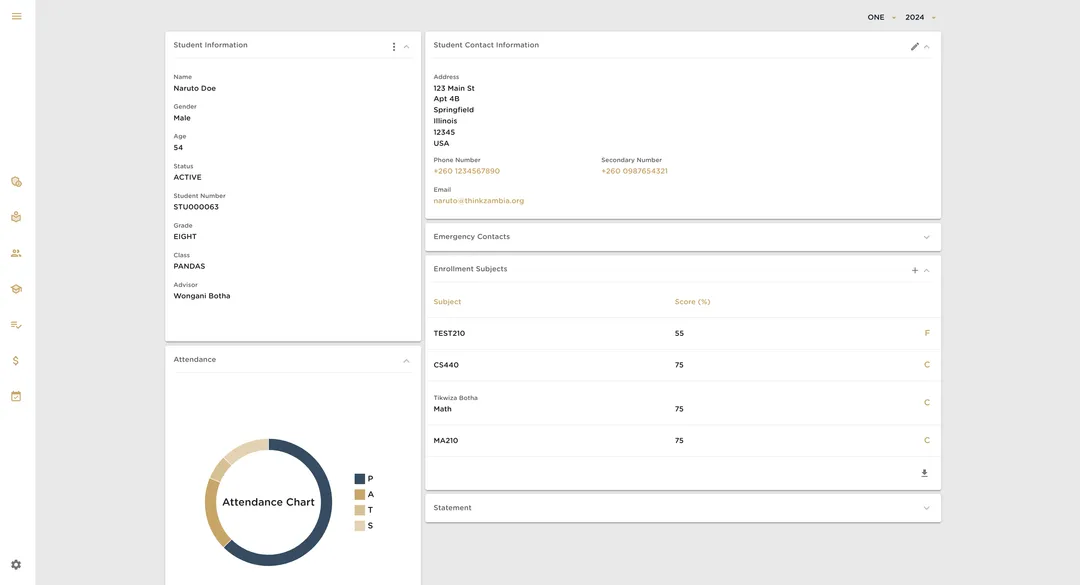
Katanga is organized around this lifecycle. Students are created once — with their personal details, contacts and emergency contacts — and then enrolled per term and year into grades and classes. Attendance, subjects, scores and billing statements all attach to the record and to the enrollment period they belong to.
Promoting a student into the next year is a new enrollment on an existing record, which means the Grade 9 enrollment comes with the Grade 8 history already attached. Archiving a student closes their active record without deleting the history the school may still need.
It is a simple model — one record, many enrollments — but it is the difference between a database of students and a history of each student.
Where schools usually start
A school does not need to reconstruct ten years of paper files to benefit from a continuous record. The pragmatic starting point is the current term: create today’s students, enroll them into today’s classes, and let the history begin accumulating from there. Within a year the record carries real depth; within a student’s school career it carries everything.
Older records can be added selectively where they still matter — for example, outstanding balances or the details of students still enrolled — rather than attempting a complete historical migration that stalls the whole effort.
For schools thinking about switching
If your current records break the journey into disconnected pieces, the fix does not have to happen all at once. Most schools start by getting current students and enrollments right, then let history build from there. Create an account to try it with your school’s structure, or browse our pricing plans by student numbers.