
A Better Way to Manage Student Attendance
Attendance is one of the oldest administrative rituals in a school. The register comes out, names are called, marks go down. It works — until the day it does not.
The paper register fails quietly. It captures the day perfectly and the term badly. It tells you who was absent on Tuesday but nothing about the student who has missed every Friday for a month. It lives in one classroom, which means the office, the head teacher and the parent each see a different piece of the picture — or none at all.
What a paper register cannot tell you
The register’s job in most schools has three parts: record the day, inform parents, and spot patterns early enough to act on them. Paper handles the first part well and the other two poorly.
Ask a class register these questions:
- How many days has this student missed this term?
- Is her attendance getting better or worse this year compared to last?
- Which class has the worst absence rate right now?
Each question is answerable in principle — the data is all there, marked in pencil. But answering them requires flipping through weeks of pages and counting by hand, which means in practice nobody asks.
What digital attendance changes
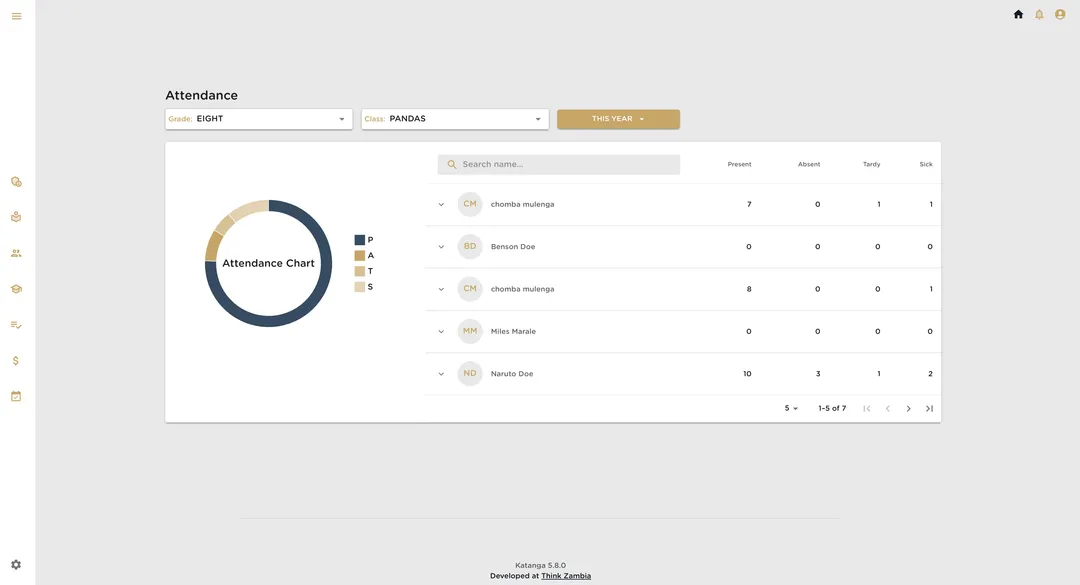
In Katanga, attendance is taken against the students already enrolled in a class — there is no separate register to maintain. Staff select the grade and class, and mark each student present, absent, tardy or sick for that day.
The difference is what happens next. Because each mark attaches to the student’s record, the system can answer the questions the paper register cannot:
- Attendance history. A student’s profile carries their record over time — by term and by year — not just today.
- Patterns, not just days. Totals of present, absent, tardy and sick days make it easy to see a student drifting toward a problem before it becomes one.
- A shared picture. The class teacher, the administrator and the head teacher are looking at the same record. There is no “register book” to physically carry to the office.
- Filtered views. Because attendance is organized by grade, class and year, a school can look at a single class, a grade, or the whole school across a term.
Attendance is connected, not isolated
The larger point is that attendance data is most useful when it is not stranded. An absence pattern matters more when it sits next to the student’s other information — the class they are enrolled in, the subjects they are taking, the guardian on their contact record who should receive the call.
That is the difference between a register and a school attendance system. The register stores marks. The system makes them usable.
Who sees attendance
Access matters as much as capture. A class teacher needs to mark their register quickly each morning. A head teacher needs to see which classes have gaps across the school. The front office needs to answer a parent’s question without fetching a book from a classroom.
Because Katanga separates roles, each of those users sees attendance in the way that fits their job — the teacher at class level, administrators and leadership across grades and years. The record is the same; the view is different. That is a quieter benefit than the history itself, but in practice it is what turns attendance from a private classroom document into school-level information.
Keeping the good parts of the register
It is worth being honest about what paper does well. A physical register needs no electricity, no connectivity and no training. Marking it takes seconds. For many Zambian schools, those are not small advantages — they are the reason paper survived this long.
Digital attendance has to earn its place by being nearly as fast at the point of capture and far more useful afterwards. That is the bar we hold Katanga to: quick to mark, organized automatically, and available to the staff who are authorized to see it.
Getting started
If your school still tracks attendance on paper and wants to see how the same process works in Katanga, create an account and load a class. The register will feel familiar. The history behind it will not.