
Introducing Katanga: A Modern Approach to School Management
Katanga is a school management system designed for schools in Zambia. It brings student records, attendance, academic results and school fees into one structured platform, so that a school can run its administration from a single source of information instead of scattered files and spreadsheets.
This post is a short introduction to what Katanga is, the problems it is built to solve, and who it is for.
The problem with scattered school records
Most schools already keep records. The issue is not whether information exists, but where it lives and how it is maintained.
A typical school might keep admissions in one register, attendance in class registers, assessment marks in teachers’ mark books, and fee balances in the bursar’s spreadsheet. Every year, student details are copied and re-entered into new books, new sheets and new lists. When a parent asks a simple question — how many days has my child missed this term, or what is our balance — the answer often requires checking several different sources.
Each of these tools works on its own. The strain shows up in the space between them: duplicated data entry, records that disagree with each other, and reports that take hours to assemble because the underlying information was never in one place.
One place for student information
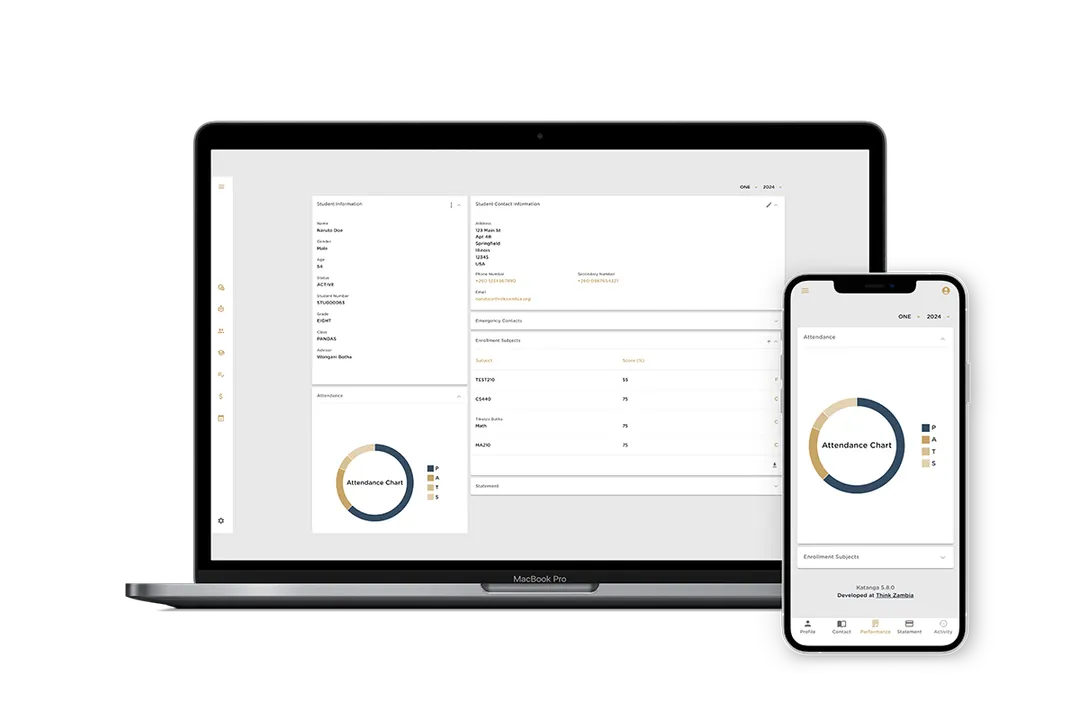
Katanga organizes school administration around a single student record. A student’s personal details, contacts, enrollment history, attendance, academic results and billing statement all attach to the same profile.
That structure changes everyday work in small but meaningful ways. When a student moves from Grade 8 to Grade 9, the school does not create a new record — it adds a new enrollment to the existing one. When a bursar checks a balance, they open the student’s statement rather than searching a separate spreadsheet. When a class teacher takes attendance, it is captured against the students already enrolled in that class.
The goal is not to digitize for its own sake. It is to stop maintaining the same information in five different places.
This also changes who can see what. The administrator setting up the year, the teacher marking a class register, and the bursar checking a balance each work inside the same system but through views matched to their role — no shared spreadsheet being passed around, and no single person who has to be asked for every answer.
What Katanga includes today
Katanga’s core areas reflect the work a school office actually does:
- Students — a searchable student list with detailed profiles covering personal information, contacts, emergency contacts, subjects and billing statements.
- Staff — a staff list with profiles for the people who run the school.
- Registration and enrollment — organizing students into the correct classes for each term and academic year, with grade and fee setup.
- Attendance — class-based attendance by grade, class and year, with present, absent, tardy and sick records kept per student.
- Assessments and grading — subjects and scores recorded against each student’s enrollment.
- Billing — school fees, invoices and payments connected to the student’s account, including online payment acceptance through ZANACO.
- Roles and access — different experiences for administrators and teachers, plus a student login on higher plans.
Some of these areas are deeper than others, and we are building carefully rather than shipping everything at once. You can see the current feature set on our features section and pricing plans.
Who Katanga is for
Katanga is built for schools in Zambia — primary schools, secondary schools, and growing institutions that are ready to move from paper files and spreadsheets to structured digital records. It suits schools where a small administrative team carries a large workload and where information needs to be trustworthy, because it is the same information used for billing, reporting and parent conversations.
Getting started
If your school is evaluating school management software, the simplest next step is to create an account and explore the platform with your own school’s structure in mind. You can also read more about Katanga or follow this blog — we will be publishing deeper articles on each part of the system over the coming months.
School administration will always involve registers, reports and records. The question is whether those records live in one place or in a dozen. Katanga is our answer to that question.